Storage unit security is all about keeping your belongings safe and sound while they are locked away in a self-storage facility.
But what does storage security mean in practical terms?
After all, the term can cover anything from simple padlocks and CCTV to sophisticated motion detectors and biometric access systems.
Deciding which of these you need to keep your possessions secure can be tricky.
Luckily, a robust approach to storage unit security is within easy reach by using a checklist like the one we have compiled here.
Below, you will find a breakdown of the locks, cameras, access control measures, and other things you need to consider if you’re thinking of entrusting your possessions to a storage facility.
Storage Facility Security Features to Look For
At a minimum, the site where you elect to keep your things should feature some or all of the following safety features:
- Perimeter fencing: Good security starts at the boundary. High fencing around the site is the first line of defence, helping to deter intruders before they even reach the building.
- Alarmed-protected units: The alarm should be connected to the monitoring systems used by staff on-site and to any remote monitoring company to which the facility delegates security during out-of-hours times.
- Gated entry: The storage facility should be secured by a substantial gate that can only be opened by authorised personnel and customers.
- Biometric access: Adds an extra layer of convenience for you as it means you can gain access to the storage facility simply using your fingerprint or a facial recognition system, meaning you don’t have to remember where you put your fob or your PIN access code.
- Motion detectors: Sensors that detect movement within the facility should ideally be installed in areas such as entry gates, corridors and other strategic locations.
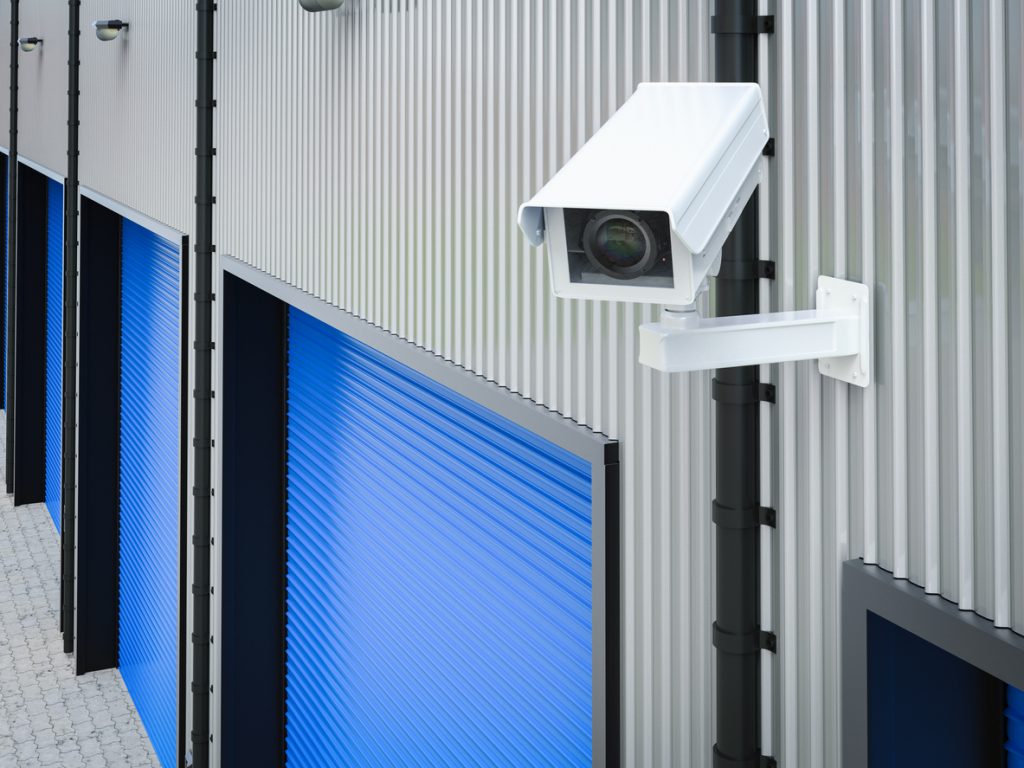
- 24/7 CCTV surveillance: Essential security technology that should be present both inside and outside the storage facility.
- Will-lit exteriors and interiors: Stark lighting on exteriors and indoors does an excellent job of warding off would-be thieves.
- Tamper-resistant unit doors: Steel roll-up (roller shutter) doors fabricated from galvanised steel should be used to secure the storage units.
- Fire detection and suppression: Sprinklers and fire alarms should be present in all units.
- Climate control: An important consideration if you plan to store temperature and humidity-sensitive items in a storage unit.
- Pest control and prevention: Rats and mice love to ferret around in unattended units, so look for storage units that have robust pest control measures in place.
- On-site staff presence and patrols: Technology does a lot of the heavy lifting when it comes to securing a site, but the human factor shouldn’t be overlooked – so make sure the facility is well-staffed and patrols are carried out regularly.
Many of the above-mentioned aren’t simply nice-to-haves – they are required by insurance companies before they will insure your stored items.
For example, if the storage units themselves and the facility’s environs aren’t surveilled by 24/7 CCTV, many insurers will refuse to issue a policy on the items you store there.
24/7 CCTV and Monitoring
On-site monitoring of the storage site using CCTV is a tried-and-trusted way of deterring would-be burglars and thieves.
In fact, the Self Storage Association UK (SSA) the UK’s standards for security requires all its members to use CCTV and access control measures as standard practice.
Video surveillance also plays an important role in the unfortunate event that your possessions are stolen or damaged, as it provides you with a visual record of what took place in and around your storage unit.
The CCTV at the storage facility should ideally feature:
- HD cameras: CCTV footage should be in high definition so you can make out the finer detail of what is being recorded, including people’s faces and even the number plates of vehicles.
- Night vision and infrared cameras: Most break-ins are committed at night, so the storage unit should ideally be kitted out with cameras capable of recording when darkness falls – that means night vision and IR technology, giving the site true 24/7 surveillance.
- Remote monitoring and alert systems: The site might not be manned 24/7, but the CCTV stream should be available at all hours from anywhere via a smartphone or computer so the company can react promptly in the event of a security breach.

Storage Insurance
Cover includes:
- Theft, Fire, Flood, Pests & More
- Instant Certificate via Email
- No Hidden Fees & No Excess
- 90% of Customers Save With Us
Access Control Systems
An access control system (ACS) is one of the most important aspects of keeping your storage unit secure.
The way a company operates its ACS and the procedures and protocols that determine how people can access the site and the storage units will tell you a lot about the company’s approach to security.
Access control is a multi-faceted and multi-layered operation at a storage facility.
As such, you should expect to find the following layers of access controls at a storage facility:
- Exterior gates and doors: The point of entry to the site should have a large barrier or gate door that opens with a code, card, fob, phone app or biometrics.
- Time-limited access: Most access control systems are only in operation during certain hours of the day – say between 6 AM and 10 PM – and access outside these times can sometimes mean you incur a fee or charge to access your unit.
- Logging: All access to the site should be logged and recorded by the facility’s computer systems so there is a record of who, where and when someone visited the site and your unit.
- Remote management: Access control is often maintained and operated remotely nowadays, so look for a facility where staff can grant, revoke, or monitor access to your storage unit without having to be physically present.
Security Patrols & Monitoring
The ability of the storage facility to monitor the storage units and the site’s surroundings plays an important role in ensuring the overall security of the storage units.
Of course, during business hours, onsite staff should be ready and able to handle security and deal with suspected breaches of units.
However, to ensure your storage unit is properly secure, you will need a facility capable of monitoring the site day and night, 365 days a year.
Nowadays, such monitoring tends to be technology-backed and reactive, not the old-fashioned man with a torch and an aggressive dog scoping out the site’s perimeter.
This means that you should look for a facility that uses out-of-hours CCTV remote monitoring and is capable of quickly dispatching remote patrols to deal with security events.
Your Responsibility: Choosing the Best Padlocks for Storage Units
The facility itself might have sophisticated access systems and a permanent on-site security presence, but it’s still your responsibility to keep your individual unit locked up.
That’s where the trusty padlock comes in.
Whether it’s a traditional key-operated lock or a combination version, a padlock is the last line of defence between your possessions and the outside world.
To ensure you are securing your items against the different kinds of break-ins and attacks – drilling, bolt cutters, blow torch – you need to find a padlock that is manufactured from high-grade metal like reinforced steel and comes in one of the following designs:
- Disc or puck padlock: These have a minimally exposed shackle and an ultra-squat design, meaning the locking mechanism is difficult to cut with a pair of bolt cutters or attack with a drilling tool.
- Reinforced closed-shackle padlock: Sometimes a longer shackle for the padlock is required if the hasp on the unit door needs more leeway – in that case, a long shackle lock should be used, with the reinforced shackle made from toughened steel (Boron), so again it’s impervious to cutting, chopping and boring tools.
Padlock CEN grades
Insurers will sometimes reject claims if a traditional open-shackle padlock is used to secure a storage unit.
This is because these types of locks can be easily removed with cutting tools.
To ensure you are securing your possessions properly and playing by the rules as far as insurance is concerned, it’s a good idea to go for a padlock with a decent CEN rating.
The main CEN grades are:
- Grade 1–2: Entry-level locks are typically used for securing things like garden sheds and outhouses.
- Grade 3: Medium security locks that are the minimum level required by many insurers for storage units.
- Grade 4: High security locks that can be found on garages, gates and storage units.
- Grade 5: Ultra high security locks used to secure transportation containers, warehouses and public buildings.
- Grade 6: Maximum security is used to secure premium goods, vital infrastructure and government buildings.
Padlock Tips
- Avoid shared or reused locks: This is especially important if the lock uses a combination to secure the shackle, as other people will know the combination, putting your possessions at risk.
- Always check the hasp and door condition: You might have a padlock with a great CEN rating, but it isn’t going to be much use if it’s attached to a hasp that is damaged or the door it secures has been compromised.
- Use the right metals: Look for a lock fashioned from Boron alloy steel, as this type of metal offers robust protection against all kinds of cutting and drilling. If your lock is to be used in a location where it will be exposed to the elements, you might want the body of the lock to be made from bronze, which has natural anti-corrosive properties.
- Take photos of your lock: Snap pictures of the lock once you have finished dropping off your items, as this will be useful should a dispute arise with the storage facility or if you have to make an insurance claim.
Don’t Label Boxes with Valuable Contents
It might be tempting to label boxes with a precise description of what they contain.
This will indeed allow you to easily locate your cherished possessions the next time you visit the storage facility, but it will also let thieves quickly identify the pricey contents, too.
Think about it: labels like ‘Electronics’, ‘Laptops’, ‘Power Tools’, ‘Jewellery’, ‘Camera gear’ just make a thief’s job that much easier when looking for boxes to rifle and goods to steal.
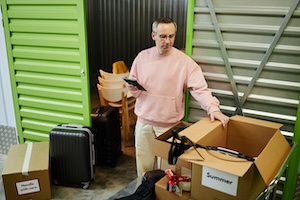
Instead, use generic labels like ‘Office supplies’, ‘Winter items’, ‘Household’, or even simply colour code or number your boxes and crates in a way that only makes sense to you.
Create a Detailed Inventory
Creating an inventory – be it using an old-fashioned pen and paper or using a digital app or Excel spreadsheet – is a good practice and will allow you to keep track of your stored items.
And remember, without an accurate and up-to-date inventory list, it may be difficult to file a claim with an insurer and have it settled equitably.
With this in mind, at the very minimum, your inventory should include:
- Brief description: The description doesn’t need to be exhaustive, but it does need to provide important information that will allow you to identify the item, such as its name, colour and estimated value: for example, sofa (2-seater sofa, black fabric): £600; x10 boxes (kitchenware): £1,200.
- Photos of items: It’s always a good idea to have visual evidence of the inventoried items, just in case there is a dispute with the facility or should you need to make an insurance claim.
- Date information: Remember to record the date of when the item was stored at the facility in your inventory – equally, if you remove an item from the storage unit, update the master list and record the date it was removed.
Consider Climate Control for Sensitive Items
In humid conditions, mould and mildew can wreak havoc on things like fabrics and papers, and the moisture in the air can also corrode metals.
To protect your stored items against this type of damage, you should opt for a unit that comes kitted out with a climate control system.
A climate-controlled storage unit should feature:
- Well-insulated door: A poorly insulated door on a unit can act as a thermal bridge, drawing in cold air in winter and warm air in summer, creating a breeding ground for all kinds of weather-related nasties like mould.
- Temperature controls: Keeping stored items at a temperature somewhere between 18–22°C is generally considered the sweet spot for items that are sensitive to temperature fluctuations.
- Humidity controls: Moisture in the air will damage papers and fabrics, so a storage facility should be able to keep the moisture at around 40–55% in your storage unit. Dehumidifiers can also be deployed in particularly damp areas.
- Air circulation: Vents should be present in the storage unit to recirculate the stagnant air – this will help prevent the buildup of mould.
- Temperature monitoring: If you have items that are extra sensitive to temperature and humidity, the unit should also come fitted with sensors for temperature and humidity control, with alarms and triggers ready to kick in.
Red Flags to Avoid When Choosing a Secure Storage Unit
If a storage facility isn’t at the top of its game, there will be red flags aplenty if you know where to look.
From the cleanliness of the site to the general demeanour of onsite staff, if something is off, you should be ready to spot it.
Some of the biggest storage unit red flags include:
- Dirt and waste in corridors
- Lax or evasive attitude among staff members
- Malfunctioning cameras and/or patchy CCTV coverage
- Overuse of pest traps
- Damage to units, especially doors and hasps
- Poorly lit corridors and inadequate perimeter lighting
- Inadequate or expired fire extinguishers
The Best Time to Visit a Storage Facility
Performing a thorough walkthrough of a storage facility is part of your due diligence before you entrust your possessions to a storage facility.
It’s recommended that you visit the facility at different times of the day before you decide on a storage unit.
This will allow you to get a handle on how the facility functions at different times.
- During business hours: Visiting during the day is a commonsense move, as it will give you a chance to see how the site operates at busy times and take in its day-to-day security procedures and protocols. The site will also be well-lit during the day, giving you a chance to scout the site’s cleanliness.
- Dusk or night: If you need evening or 24-hour access, it’s good to see how the facility operates during off-peak hours. Visiting at dusk or nightfall will also give you a chance to see how well-lit the location is when it’s most vulnerable to break-ins.
Why Insurance Matters (Even in Secure Facilities)
Insurance is a vital backstop when it comes to your storage unit. Most storage facilities require you to have cover in place before they’ll accept your items, and it’s easy to see why – theft and fires do happen, even in secure facilities.
Storage insurance will typically cover you against theft, fire and pest infestations, but some policies go the extra mile and will also cover the transportation of your possessions to and from the storage facility, too.
While many facilities offer their own insurance, it’s usually cheaper to find cover elsewhere through a third-party provider. This can also give you more flexibility over the level of cover and the items you’re protecting.