If you are thinking of keeping some of your possessions in a storage unit, it’s essential you get one thing right – the dimensions of the space you need.
Get them wrong, and you could end up with a unit that is too large for your needs, resulting in overpaying for storage space.
Underestimate your requirements, and you’ll either have to move everything to a larger unit or put up with having your things spread inconveniently over several units.
Either way, size matters.
So the first question you should have firmly in the front of your mind if you are planning to use a storage unit is: ‘What size storage unit do I really need?’
In this post, we will help you answer this question.
Storage Unit Sizes Explained
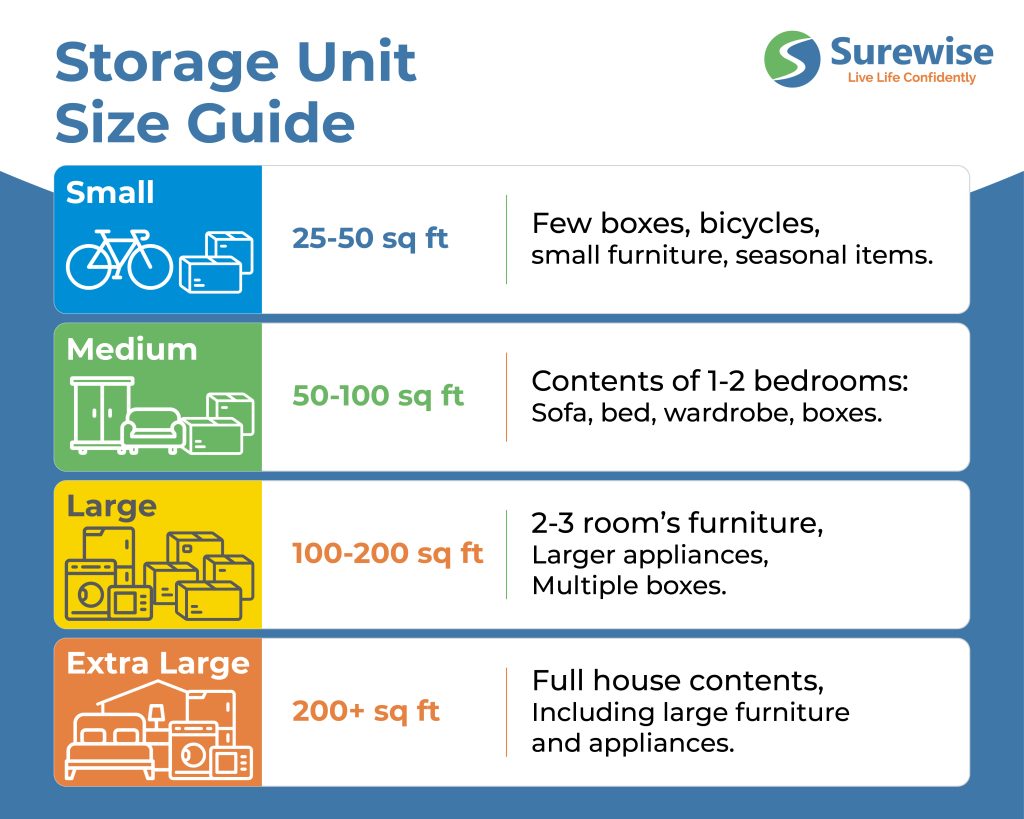
There are, broadly speaking, four sizes of storage units available for rent:
- Small (25–50 sq ft): Perfect for storing boxes of miscellaneous items, small pieces of furniture, bikes, seasonal decorations, and personal items when decluttering a single room.
- Medium (50–100 sq ft): Provides space enough to store a couple of rooms of furniture, bulky household appliances, and mattresses. Ideal if you want to outsource storage for a 1-bedroom flat or studio.
- Large (100–200 sq ft): Can accommodate the contents of a typical 2–3 bedroom home, including furniture, appliances, and boxes. This size of storage unit is required if you are moving home, downsizing, or need somewhere to store your personal possessions during a major house renovation.
- Extra Large (200 sq ft+): Suitable for larger homes, full office contents, and bulky items like large appliances, vehicles, or extensive private collections.
Three-Dimensional Space
The dimensions of a storage unit are always given in two dimensions in either square feet (ft²) or square metres (m²), measuring the floor space available.
This means it’s easy to overlook that you have a third (vertical) dimension to play with when using a storage unit.
Many items, especially if they are boxed up properly, can be safely stacked vertically, allowing you to utilise approximately 8-10 feet of vertical space.
So bear in mind that while the space size of the unit you are interested in is quoted in square feet, you actually have a lot more space at your disposal.
Making the Most of Storage Space
- Make sure you use all available vertical space as well as the floor space – you can do this by packing as many of your items as possible into stackable boxes or cartons, and remember to use the unit’s shelving, too
- Disassemble furniture you plan to store in the unit, as this will make it easier to pack it into tight spaces
- Keep frequently used items near the front of the unit and within easy reach so you can access them easily
- Remember not to overpack the space and to leave access paths between boxes so that you can easily access and retrieve items
How to Estimate What Storage Space You Need
Perhaps the easiest and most convenient way to estimate the storage space you need is by ‘boxing’ all the items you want to store.
This involves imagining how many boxes each item would require if stored in a series of standard-sized packing boxes (see below).
This will allow you to translate all of your personal possessions you want to keep in storage into several standard-sized cubic units (ft³), each with a well-defined volume.
By thinking in these terms, you can better visualise how much space you will need and how your items will stack or pack together once in the storage unit.

Storage Insurance
Cover includes:
- Theft, Fire, Flood, Pests & More
- Instant Certificate via Email
- No Hidden Fees & No Excess
- 90% of Customers Save With Us
Boxing Clever
- Dining chair = 2-3 boxes.
- Office chair = 3-4 boxes.
- Bedside table = 3-4 boxes.
- Chest of drawers = 6-8 boxes.
- Wardrobe (dismantled) = 8-10 boxes.
- Double mattress = 16-18 boxes.
- Sofa (2–3 seater) = 10-12 boxes.
- Dining table = 8-10 boxes.
- Washing machine or tumble dryer = 6-8 boxes.
- Bicycle = 5-7 boxes.
Give Yourself a Buffer
It’s advisable to overestimate the space you need by around 10–20%.
This will mean you don’t have to cram your possessions in too tightly, and also have enough space to pack and unpack items safely and conveniently.
A buffer of at least 10% will also make it much easier to locate your items when you return to the unit to retrieve them.
Buffer Examples
- If you calculate that you will need a 50 sq ft unit, round up this figure to 55–60 sq ft.
- For a 75 sq ft unit, a 10% buffer means you will need around 83 sq ft to store your items comfortably.
- For an extra-large 150 sq ft unit, a 10% buffer means you will require approximately 165 sq ft, giving extra space for storing items and moving around the unit.
Small Units (25–50 sq ft)
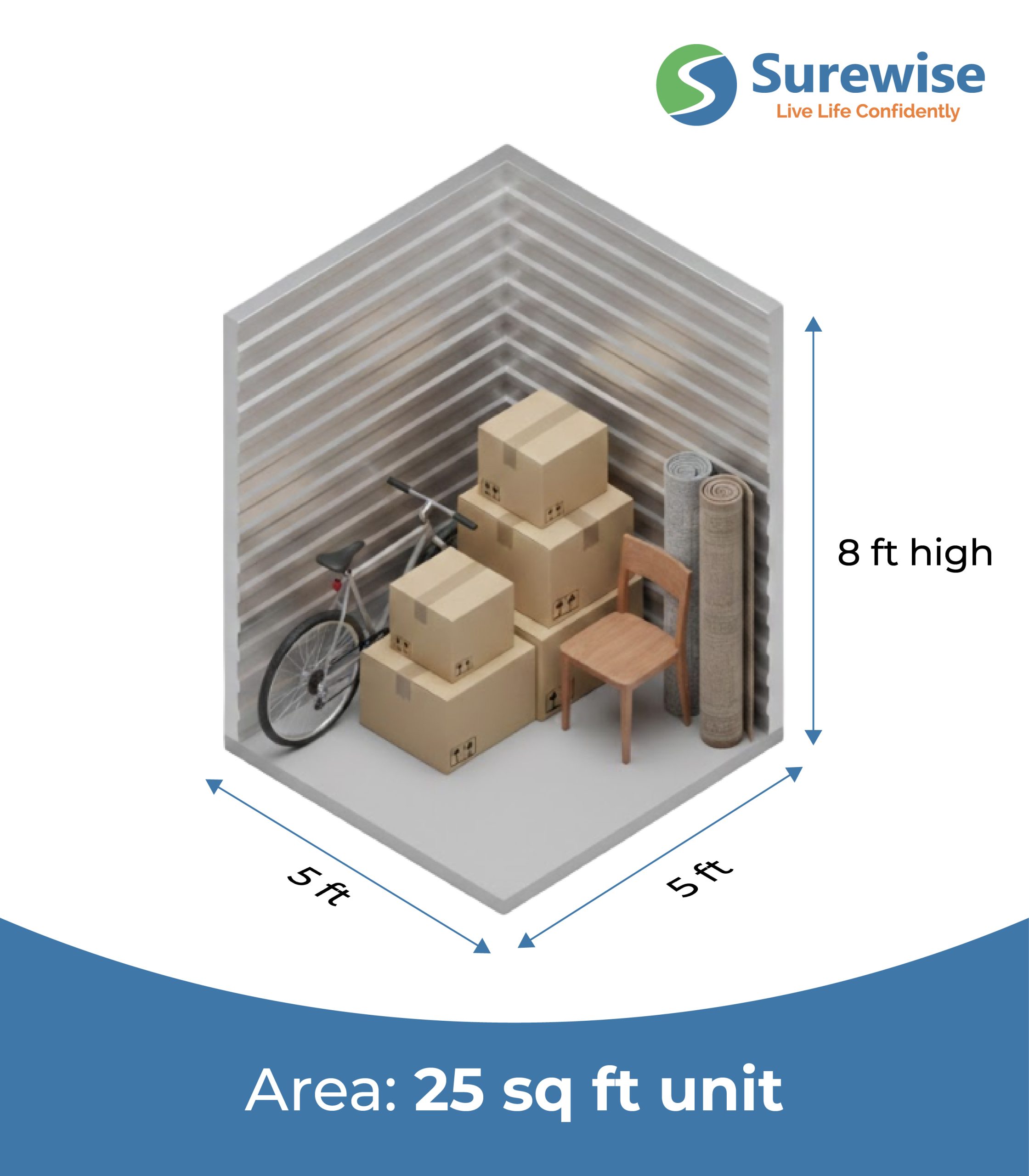
A small storage unit provides about as much room for your things as a garden shed or a walk-in wardrobe.
Affording at least 200 ft³ of space, a small storage unit provides ample room to store items like small bits of furniture, a bicycle and garden chairs.
What Fits in a Small Storage Unit?
Here is an example of what you might comfortably and safely store in a small storage unit:
- A small sofa or armchair
- A chest of drawers or bedside cabinets
- An adult bicycle
- Carpets and rolled-up rugs
- Seasonal items such as suitcases, garden chairs, and sports equipment
- Office items like filing cabinets and archive boxes
Summary
- Perfect for: Storing the contents of a small room, decluttering a single room, and students switching accommodation
- Box capacity: A small storage unit can comfortably accommodate approximately 50 standard storage boxes (18″ × 14″ × 12″)
Medium Units (50-100 sq ft)
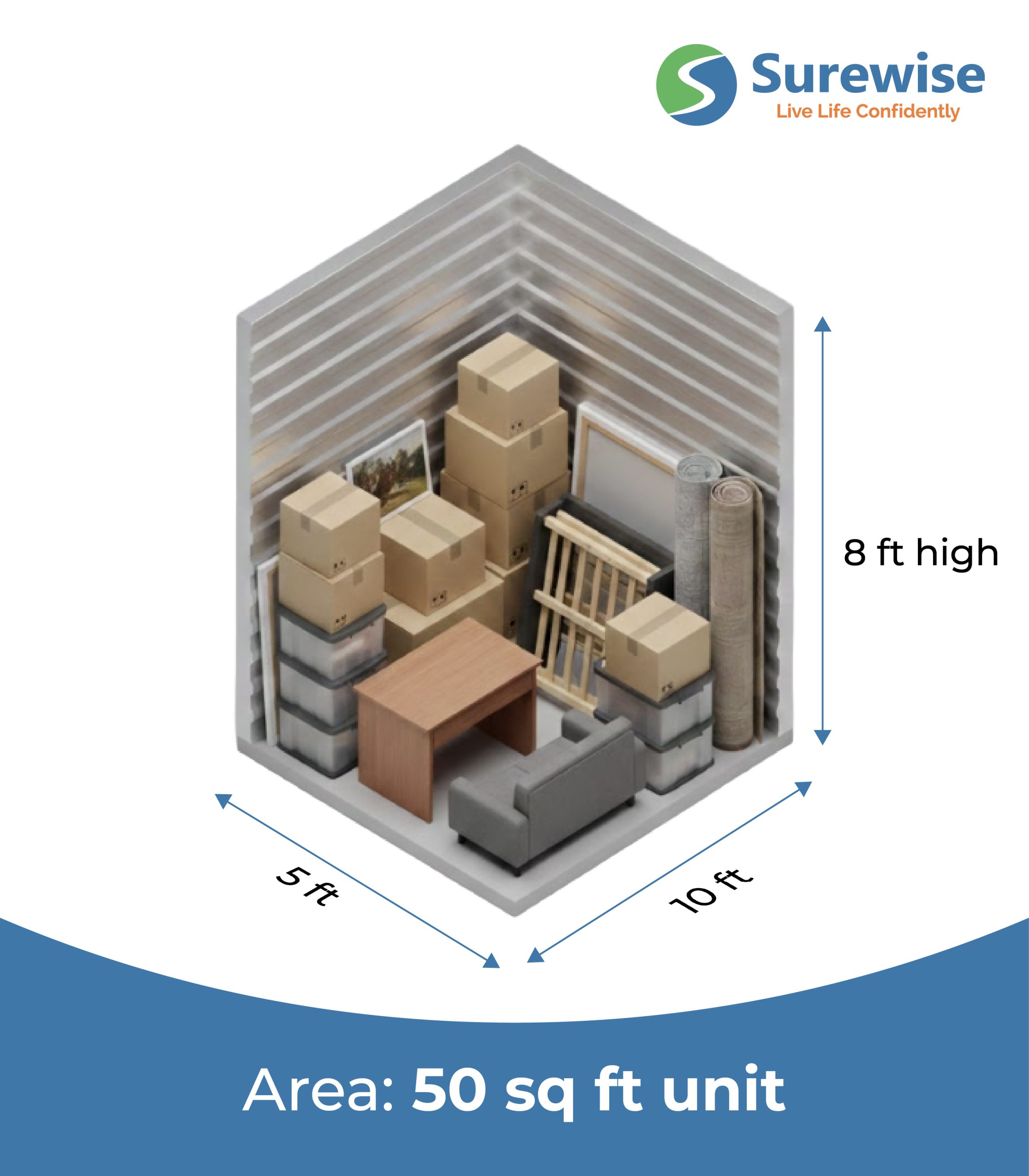
The next step up in space is a medium-sized unit, which typically provides a similar amount of space to a parking bay or half a regular car garage.
And at around 8 ft high, a medium-sized unit will provide approximately 400 ft³ of usable space.
What Fits in a Medium Storage Unit?
An example of what you might store comfortably and safely in a medium storage unit:
- A double mattress
- A bed frame (disassembled)
- Bedroom furniture, such as drawers or a wardrobe
- Sofa or armchair (2-seater)
- A coffee table
- A couple of bicycles and smallish gym equipment
- A kitchen appliance like a domestic washing machine
Summary
- Perfect for: Storing the contents of a one-bedroom flat, decluttering multiple family rooms in a house, or storing items during a house move or renovation.
- Box capacity: A medium storage unit can comfortably accommodate approximately 150 standard storage boxes (18″ × 14″ × 12″).
Large Units (100 –150 sq ft)
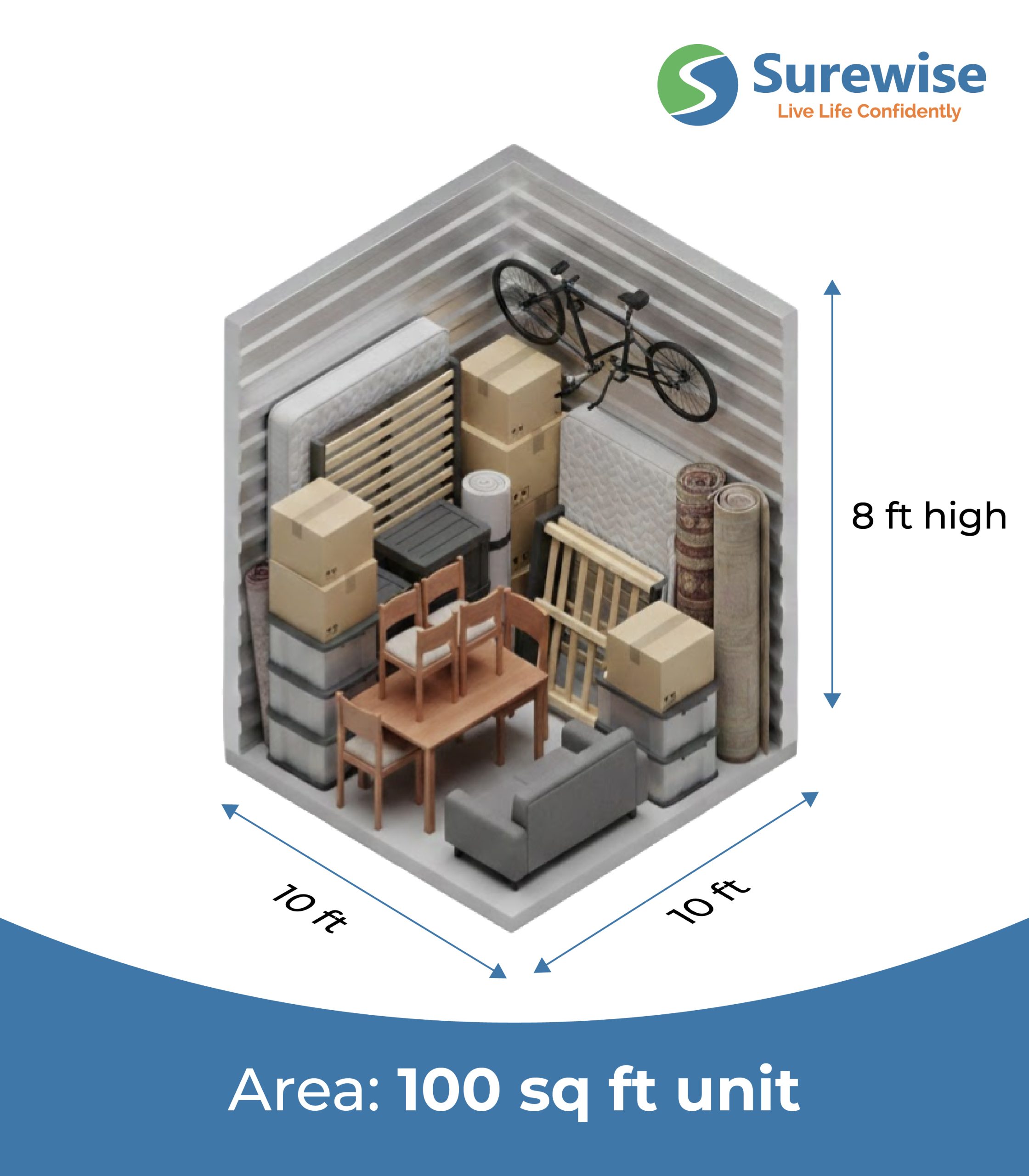
A large storage unit will provide you with roughly the same amount of space as a standard single-car garage.
Add in the 8ft of vertical space, and that gives you a minimum of approximately 800 ft³ of usable storage, comfortably enough space to accommodate the contents of, say, a 2-bedroom home.
What Fits in a Large Storage Unit?
Here is an example of what you might comfortably and safely store in a large storage unit:
- Sofas and armchairs
- A dining table and chairs
- Double bed, mattresses, wardrobes, and chests of drawers
- Large appliances such as fridges, washing machines, and tumble dryers
- TVs, mirrors, pictures, and boxed household belongings
Summary
- Perfect for: Storing the contents of a 2–3 bedroom home during a house sale or home renovation, or even long-term furniture storage.
- Box capacity: A large storage unit can comfortably accommodate approximately 200 standard storage boxes (18″ × 14″ × 12″).
Extra Large Units (200+ sq ft)
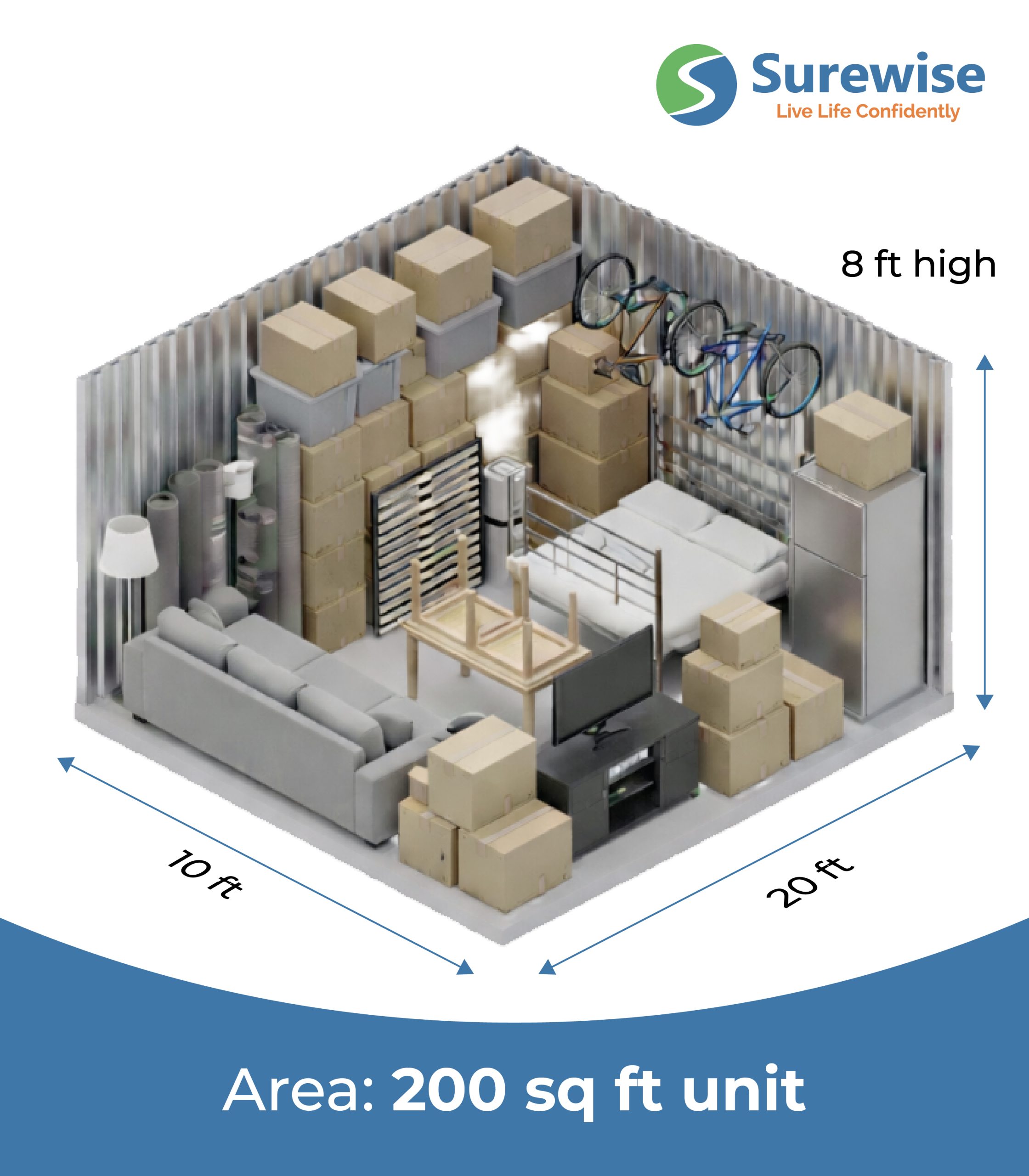
An extra-large storage unit provides expansive storage space comparable to two standard garages combined.
Giving at least 900 ft³ of space, an extra-large storage is ideal for storing the contents of a large family home or multiple rooms’ worth of furniture and belongings.
What Fits in an Extra-Large Storage Unit?
Here is an example of what you might comfortably and safely store in an extra-large storage unit:
- Furniture from multiple rooms, including sofas, beds, wardrobes, and dining sets
- Large household appliances such as fridges, washing machines, dryers, and ovens
- Extensive boxed personal belongings
- Oversized items and long-term storage contents
Summary
- Perfect for: Storing the contents of a 3–5 bedroom home during a house move or a major refurbishment, or business storage (inventory, machinery and files)
Box capacity: An extra-large storage unit can comfortably accommodate approximately 300 standard storage boxes (18″ × 14″ × 12″)
| Room | Suggested Unit Size | Approx. Box Eqv. | Can Store |
|---|---|---|---|
| Spare Bedroom | Small/Medium | 40–60 boxes | Single bed or sofa bed, chest of drawers, bedside table, mirror, wardrobe of clothes, and bed linen. |
| Standard Bedroom | Medium/Large | 120–200 boxes | Single or double bed and mattresses, wardrobe (disassembled), chest of drawers, bedside tables, plus 10–20 boxes of misc. items. |
| Fully furnished Living Room | Medium/Large | 120–200 boxes | 2–3 seater sofa, coffee table, TV and unit, rugs, lamps, 10–20 boxes of living room items. |
| Kitchen | Medium/Large | 120–200 boxes | Fridge freezer, washing machine, dishwasher, shelving units, and boxed up kitchen items |
| Dining Room | Medium/Large | 120–200 boxes | Dining table, 4–6 chairs, sideboard or cabinet |
| Hallway | Small/Medium | 40–60 boxes | Coat racks, shoe storage, vacuum cleaner, cleaning equipment, seasonal items |
| Bathroom | Small/Medium | 40–60 boxes | Shelving units, towels, toiletries, and cleaning equipment and supplies |
| Utility room | Medium | 60–120 boxes | Washer, dryer, shelving, detergents, and household equipment |
Quick Size Guide By Situation
Storage units come in especially handy during spring cleans, student accommodation switches, and for businesses looking to keep inventory and files off-site.
With those use cases in mind, below we take a look at the storage space you will need in each of these scenarios.
Decluttering: What Size Storage Unit Do I Need?
| Category | Typical Items Stored | Approx. Boxes | Recommended Unit |
|---|---|---|---|
| Seasonal Items | Coats, suitcases, Xmas decorations, ski equipment and garden items | 34–36 | Small |
| Collections | Books, vinyl records, DVDs, board games, and arts and crafts supplies | 38–46 | Small-Medium (at the upper end, a larger unit is recommended if items are collectable/valuable) |
| Archives | Documents, photo albums, keepsakes, and heirlooms | 18–20 | Small |
| Sports & Hobbies | Bicycles, scooters, skis, and camping gear | 27–36 | Small |
Student & Temporary Storage: What Size Storage Unit Do I Need?
| Scenario | Approx. Boxes | Recommended Unit Size |
|---|---|---|
| Single dorm room / 1-bed flat | 25–40 | Small |
| Shared flat / 2–3 students | 55–80 | Medium |
| Temporary storage for renovation/move | 45–65 | Small (lower)–Medium (upper) |
| Graduate / young professional with 1–2 bedrooms | 70–90 | Medium |
Business Storage: What Size Storage Unit Do I Need?
| Use Case | Typical Items Stored | Approx. Boxes | Space Needed (sq ft) | Recommended Unit |
|---|---|---|---|---|
| Small Office | Files, desks & chairs, IT equipment, stationery | 70–100 | 50–100 | Small or medium (at the upper end, and especially if regular access is required) |
| Tradesperson / Small Contractor | Tools, tool chests, materials, ladders, spare parts | 55–80 | 50–75 | Medium (ground-floor unit recommended for heavy items) |
| Retail Shop Storage | Seasonal/overflow stock, shelving, POS & signage | 110–165 | 50–100 | Medium or large (if signs need to be stored unassembled) |
| Office Move / Renovation | Desks & chairs, filing cabinets, IT & comms | 100–130 | 50–100 | Medium |
| Long-Term Business Storage / Archives | Paper records, equipment, surplus furniture | 150–300+ | 120–200+ | Large/extra Large |
Can You Upgrade or Downgrade Later?
Most reputable storage facilities will allow you to switch between storage units, both during and at the end of your rental agreement.
The most flexible facilities will only expect you to pay for the rent due on the new unit, even if your current rental agreement hasn’t ended.
However, it’s important to note that some storage companies won’t rebate the difference in rent if you decide to downgrade mid-lease.
It’s often better to run down your current lease and re-sign for the unit with the capacity you want to avoid this issue.
Insurance Considerations by Unit Size
When it comes to taking out storage unit insurance, it’s important to bear in mind:
- The size of the unit plays an important role in determining the temperature of a storage unit – smaller units are more prone to temperature swings, meaning they are more vulnerable to damp and condensation, damage caused by which is usually covered by insurance.
- With large and extra-large units, it can be easy to under-declare the value of your possessions if you don’t inventory items properly – this can lead to ‘proportionality’ being applied in insurance payouts, which means if you lose £2,000 of stock, you may only receive half that sum (£1,000) if it’s subsequently discovered that you have undervalued your goods by 50% when taking out the insurance.
- Smaller storage units sometimes face more exclusion-based denials during insurance claims because it’s often asserted that the storage space itself contributed to the damage, so make sure you rent the right size of unit for your items.
- If in doubt, you should go a size up, as larger units reduce the insurer’s argument that packaging and ventilation were inadequate when it comes to assessing a claim.